
Burke Three-Day Feed Status
The Burke County Sheriff Inmate Inquiry is a current-inmate source. It is not identified as a release archive, and the research confirmed no separate 72-hour release page. A person who left the jail during the prior three days may no longer appear. That absence is useful as a lead, but it does not identify the date, release basis, destination, or agency that assumed custody.
A three-day review works best as a reconciliation. Compare an earlier custody result with today's inquiry. Then check VINE, court events, and any release sheet supplied by the sheriff. This captures changes that a single current-roster view cannot preserve.
Check Burke Three-Day Releases
Use the date range in the request itself. A rolling 72-hour period is not always the same as three calendar dates, so state the exact beginning and ending date and time. For a same-day event, use Released Last 24 Hours.
- Check the sheriff inquiry for present local custody and save known identifiers.
- Search Georgia VINE for a participating agency's status change.
- Review the controlling court for bond, disposition, sentence, or transfer orders.
- Use GDC Find an Offender only if state custody is plausible.
- Send the sheriff an open-records request for release sheets within the exact range.
For a list request, ask whether records can be searched by release date rather than by one name. The office may explain the form in which records are kept. If only a named-person request is practical, provide the full name, booking number, booking date, and case number.
Burke Three-Day Record Fields
No online Burke three-day field set was verified. These are the fields to seek in the official booking/release record, not fields claimed to appear in Inmate Inquiry.
| Field | Use across 72 hours |
|---|---|
| Name and booking number | Identifies the correct admission. |
| Release date and time | Places the event inside the requested window. |
| Release type | Distinguishes bond, time served, sentence end, or an order. |
| Facility or agency | Shows which custody system made the entry. |
| Transfer or hold | Explains why county custody ended without full release. |
Release from Burke County Jail can coexist with custody elsewhere. A transfer to GDC, another jail, federal custody, or immigration custody ends the local booking but does not mean the person is free. A detainer is another agency's request to hold or receive the person. Ask for that notation when the next destination is unclear.
Burke Weekend Release Checks
Weekends and holidays make a wider period useful because the custody event, court event, and public data update may not appear at the same moment. A bond hearing may explain the legal authority. The jail record supplies the actual local release time. VINE may then report the custody change from a participating agency. These are related records, but they are not interchangeable.
Burke County Magistrate Court handles first appearances and bond hearings. State Court handles misdemeanor matters, while Superior Court handles felony cases. The Clerk of Superior, State, and Juvenile Court is the practical records contact for filed case material. Use the named-person release search when one individual, rather than the whole period, is the goal.
Do not infer a holiday rule that the research does not document. Instead, ask for the exact event time and the order or authority tied to it. A later web update does not change the time written in the agency record.
Burke Three-Day Request Fallback
Submit a focused request to the sheriff for booking/release sheets, release dates and times, release types, and transfer destinations covering the defined period. The official open-records page is the local route. If the result needs legal context, pair it with the court order or docket entry. If a state sentence followed the county booking, shift to GDC for state custody and release fields.
Georgia VINE is most useful before an expected release because it can send a custody-change notice. It is not a certified court disposition or a complete historic archive. Likewise, GDC does not document a routine county bond-out. Federal BOP and ICE sources are separate and should be checked only when the case points to those systems.
- Release
- The end of custody by the reporting agency.
- Transfer
- Movement from one custodian to another.
- Disposition
- The court's recorded outcome or action in the case.
Burke Roster Retention Limits
The sheriff's public retention period and update cadence were not confirmed. That is the core Burke County data quirk. Inmate Inquiry shows current information, while a person released during the prior three days may simply disappear from view. A screenshot or prior note can help show that a record changed, but only the sheriff's source record can confirm why.
The official inquiry screen illustrates the current-custody starting point.
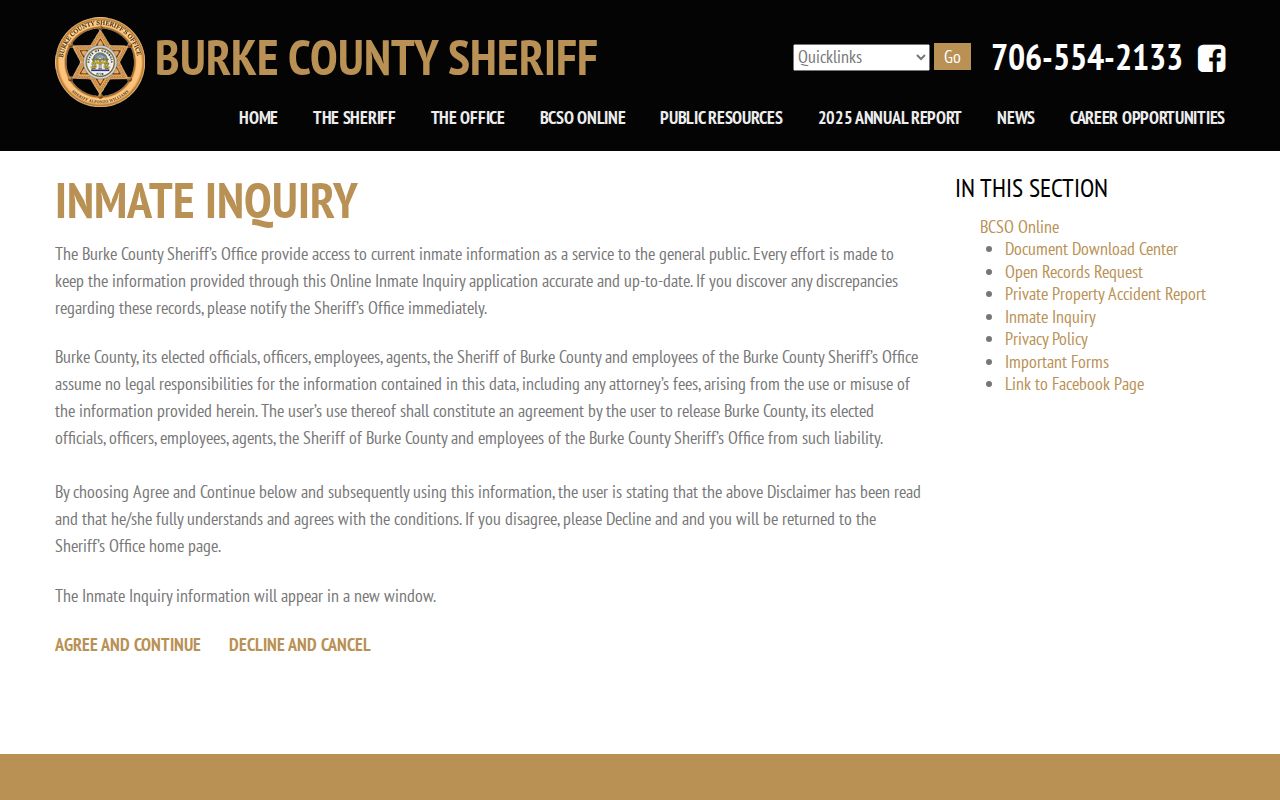
The screen should be read as a present-status tool, not as a verified three-day release list.
For an older event, request the release sheet. For a court explanation, use the clerk. For state custody, use GDC. This split prevents a missing local roster entry from being mistaken for a final outcome.
Reconcile Burke Release Dates
A three-day check can cross several record dates. The booking date marks admission, the court-event date marks judicial action, and the release date marks when the jail's custody ended. A web update may carry yet another timestamp. Keep these dates in separate columns rather than forcing them into one sequence.
Start a simple event log with the source beside each entry. Record when Inmate Inquiry was checked, when VINE reported a change, when the court entered its order, and what time the release sheet gives. If one event falls just outside the rolling 72-hour window, the log explains why it still relates to the same custody change.
This method is useful after a long weekend. It also helps when a bond order is entered on one day but release processing ends on the next. The court order explains authority. The sheriff record confirms the actual local event. Neither should be replaced with an assumed update schedule.
Burke Three-Day Custody Routes
The next lookup depends on where custody went. A person released on bond stays tied to the Burke court case. Someone transferred to a Georgia state prison belongs in GDC Find an Offender. A parole release adds State Board and Department of Community Supervision records. Federal prison and immigration systems have their own locators and do not become Burke County release records merely because the case had a local connection.
Ask for the destination or hold notation when the local record says transfer. That single field can prevent hours of searching the wrong system. If no destination is given, use the case and booking identifiers when contacting the clerk or custodian. Exact identifiers matter more than a broad date range when names are common.
Note: The end of Burke County custody may begin another agency's custody, so verify the receiving system before concluding that all confinement ended.
Request Burke Release Date Ranges
A useful records request defines the three-day window and the document sought. Ask for jail booking/release sheets indexed by release date, if the office keeps them in that form. State the beginning and ending timestamp, and ask for the release date, release time, release type, booking number, and transfer destination fields contained in the responsive records.
Do not ask the custodian to decide what happened based on a roster gap. Request the existing record instead. If the office cannot produce a date-range list, narrow the request with names and identifiers. The clerk can separately provide court material, but a court docket is not a substitute for the jail's actual release timestamp.