
Burke County Scheduled Versus Actual Release
A scheduled or projected date is a calculation based on the information in force at that point. The actual release is the custody event that occurs after staff review the sentence, credits, court orders, detainers, and release plan. Those dates may match, but they are not the same fact. A database date should be treated as a planning point until the custody agency confirms release.
Pretrial detainees generally have no computed sentence-expiration date. Their release may turn on bond, first appearance, a dismissal, a plea, or transfer. Burke County Magistrate Court handles first appearances and bond hearings. State Court handles misdemeanors and traffic cases, and Superior Court handles felonies. The court record can explain the event even after a person drops from the jail inquiry.
A sentenced person has a different path. A short or local jail sentence is calculated by the jail under the sentencing order and credits that lawfully apply. A state felony prison sentence moves the release-date question to the Georgia Department of Corrections and, if parole is possible, the State Board of Pardons and Paroles.
Find a Burke County Projected Release
Begin with the system holding the person. The Burke County Sheriff’s current-inmate inquiry is useful for present local custody, but research found no public projected-date field or recent-release archive that can be promised. GDC Find an Offender is for people who entered state prison custody. Federal and immigration systems have their own tools.
- Identify the custody type. Decide whether the person is in Burke County Jail, GDC custody, federal prison, immigration detention, or another county.
- Check current local custody. Use the Burke County Inmate Inquiry. If the person is absent, verify release or transfer rather than assuming either.
- Check the court event. For a local case, obtain the bond order, sentencing entry, dismissal, or transfer order from the appropriate Burke County court.
- Search GDC for a state sentence. Use GDC Find an Offender, match identifiers, and read the exact release-date label on the live detail page.
- Check parole timing. Use the TPM lookup for a parole-eligible state inmate. Do not turn a tentative month into a promised day.
- Check for another hold. A detainer, warrant, or transfer order can keep the person confined elsewhere after release from the first agency.
- Confirm the event. Use the custody agency, court record, or notification system when the expected date arrives.
GDC asks users to verify offender information through written correspondence with Inmate Records and Information at PO Box 1529, Forsyth, GA 31029 before treating it as complete. That step is useful when two screens conflict or a date has high practical importance.
The official GDC offender-search agreement is shown below.
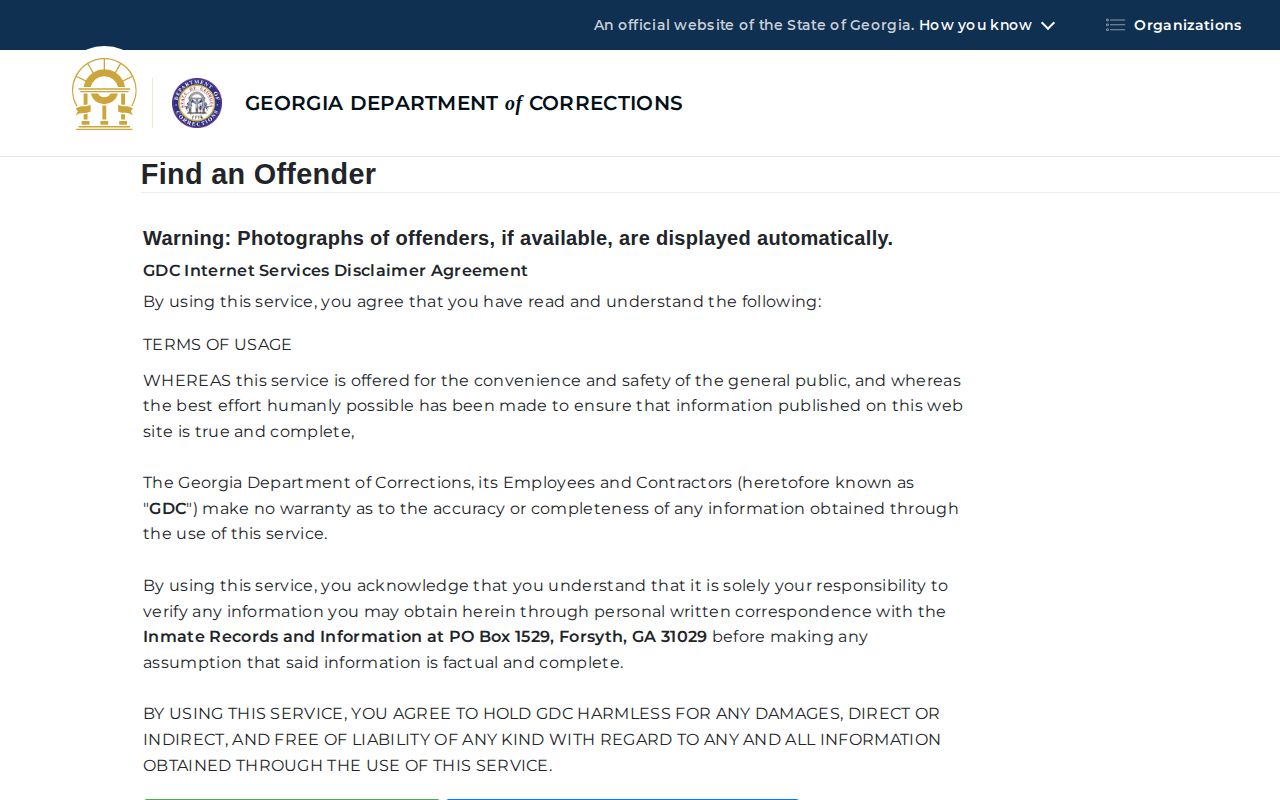
This state search may show a release date and offender photo when available, but it is not a Burke County Jail release roster.
Burke County GDC Release Fields
GDC’s friend-and-family guidance says Find an Offender can show charges, facility location, and release date. The live offender detail should control the wording. Georgia screens can distinguish a release date, facility, sentence information, and custody or discharge status, but the exact label must be copied from the result rather than translated into another state’s terms.
| Record item | How to read it |
|---|---|
| Custody or facility | A current GDC location points to state custody; no local jail conclusion follows. |
| Release date | Use the exact GDC label and treat it as date-sensitive. |
| Sentence data | Compare with the sentencing court entry and offense category. |
| GDC identifier | Use it to avoid matching a person with a similar name. |
| Photo, if available | This is a state offender image, not necessarily the Burke County booking photo. |
| Parole link or status | Use Board tools for tentative timing and post-release parole dates. |
The GDC questions page directly describes the offender search as a source for location and release date.
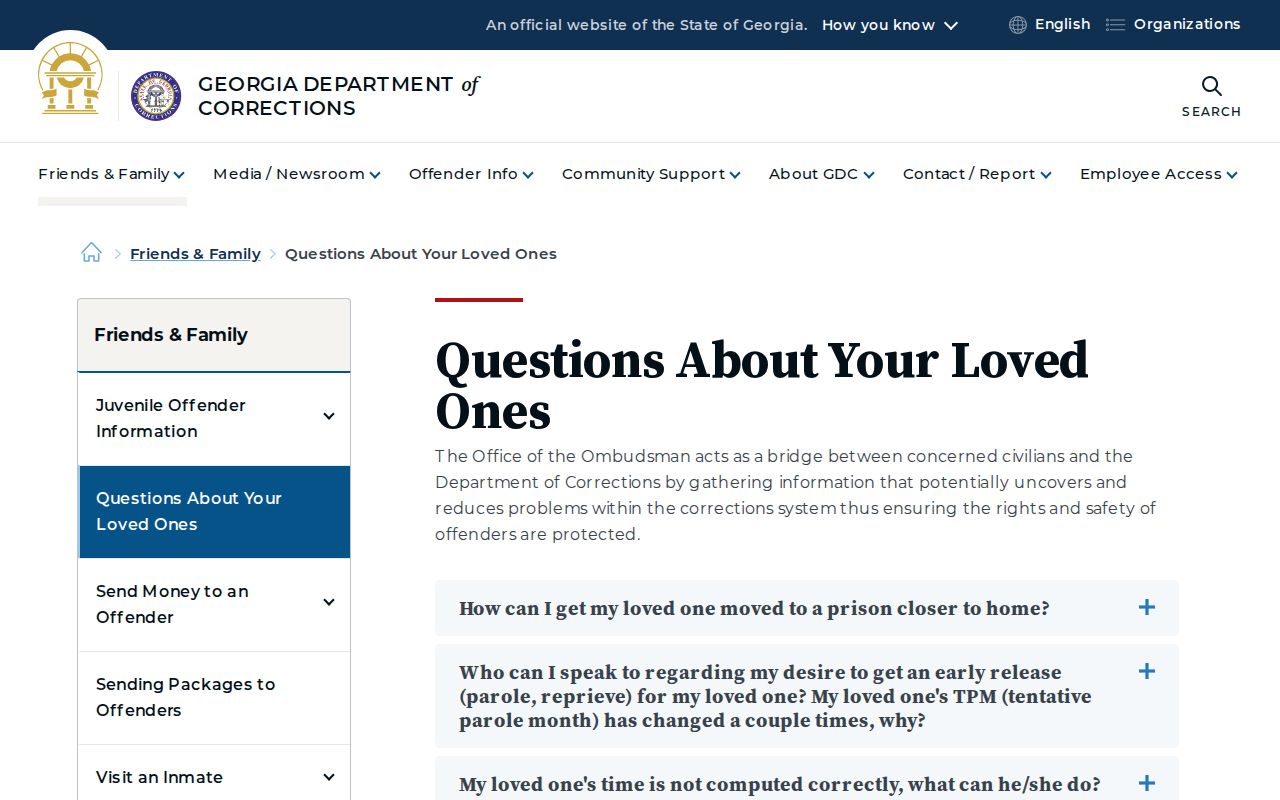
That guidance supports a state-prison lookup. A local bond release still belongs with the sheriff and court.
Georgia Parole Month Is Tentative
Georgia’s key release-date quirk is the Tentative Parole Month, or TPM. The State Board TPM explanation defines it as the month in which final review occurs and, if appropriate, a parole release date is set. It is not a final parole decision. A reader should never treat it as a fixed release day.
The Board may reconsider information up to release. A TPM may be advanced through Performance Incentive Credit, delayed for poor conduct, cancelled, or replaced by a denial or later review. Residence approval, conditions, institutional conduct, program work, a new court event, and a detainer can affect the result.
The matching Georgia Board TPM source appears here.
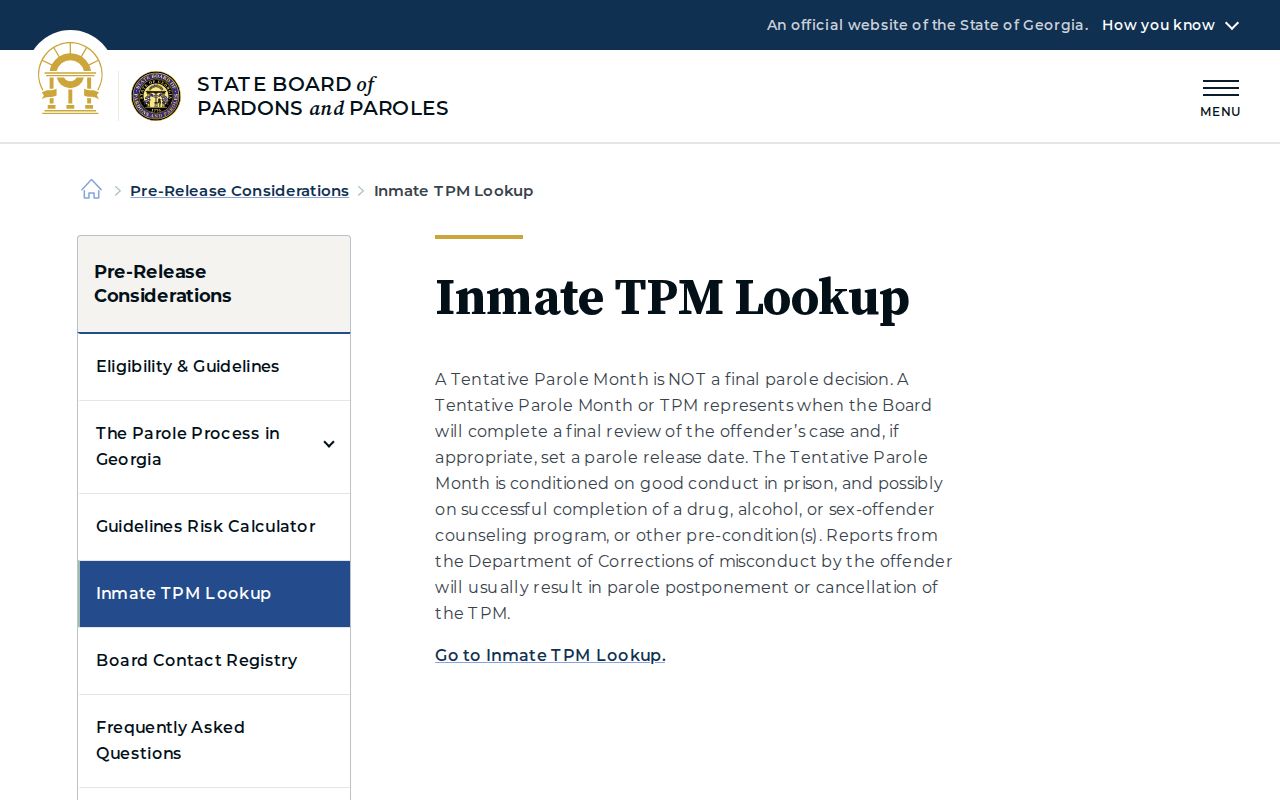
Its warning is why projected-date content needs more than a simple fraction of the sentence.
Burke County Release Credit Rules
Georgia does not impose one flat “serve 85 percent” rule on every state inmate. General parole eligibility under O.C.G.A. 42-9-45 is often after nine months or one-third of a felony sentence, whichever is greater, but statutory exceptions apply. For terms totaling 21 years or more, eligibility can occur after seven years unless another law controls. Eligibility means the Board may consider parole. It is not a release order.
O.C.G.A. 17-10-6.1 sets mandatory punishment and parole restrictions for serious violent felonies. Certain serious violent crimes committed on or after January 1, 1995, fourth-or-more felony recidivist cases, and life without parole can fall outside ordinary parole treatment. The precise offense date and sentence matter.
Performance Incentive Credit is the parole-timing feature described by the Board. When parole is tentatively scheduled, the Board can set both a TPM and PIC date. The span between those dates is the most the TPM may advance through favorable conduct and performance. The Board says poor performance can add time without a fixed cap. Life sentences, a TPM at one-third, work release, boot camp, sentences of two years or less, and cases denied parole with no TPM are listed as ineligible for PIC.
The Board’s decision guidelines explain PIC and detainer effects.
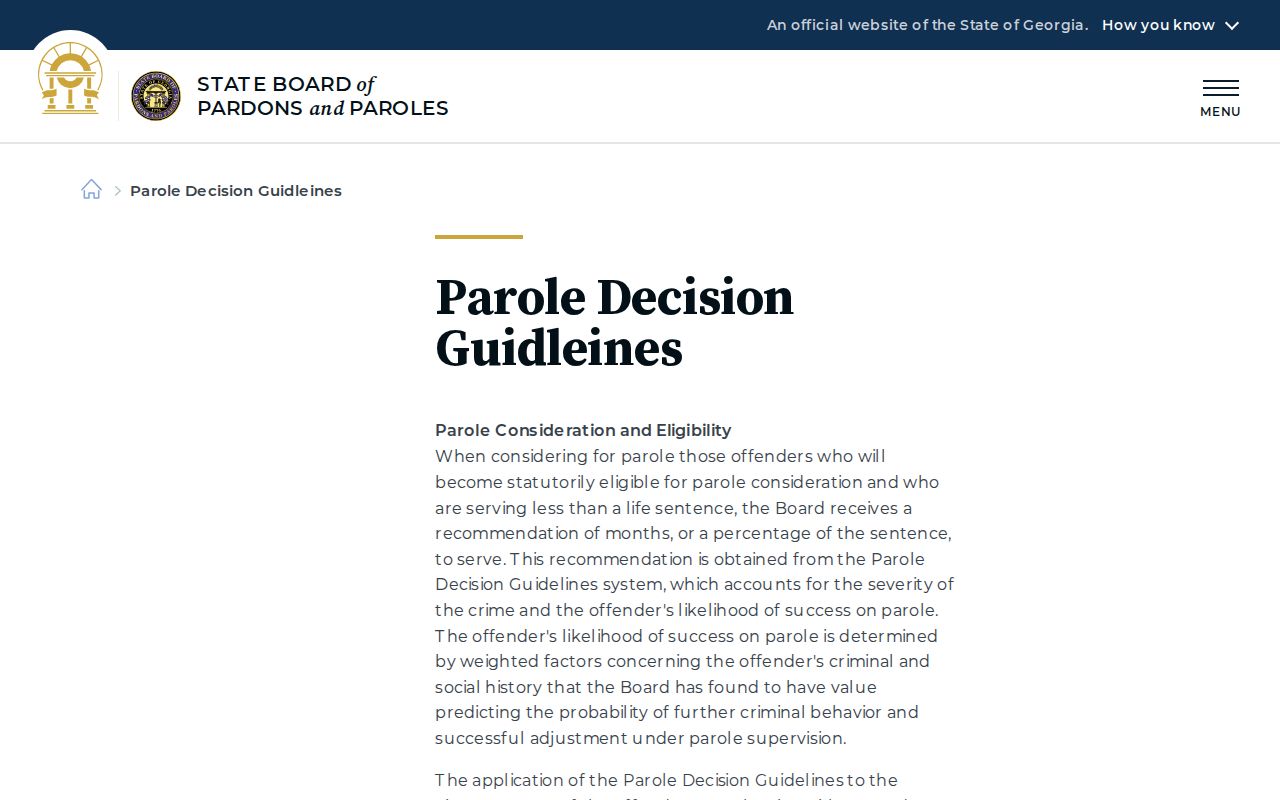
This guidance affects a state parole timeline, not a local pretrial bond decision or a simple county release calculation.
Why Burke County Release Dates Change
| Factor | Possible effect | Best source |
|---|---|---|
| Bond or court order | Creates or changes a local jail release path | Burke County court record |
| Sentence correction | Changes the lawful term or credit | Sentencing court and custody agency |
| Institutional conduct | May advance or delay parole timing | GDC and Parole Board |
| Parole decision | Sets, changes, or denies an early release path | TPM and Board records |
| Detainer or warrant | Can cause transfer or continued custody elsewhere | Agency that issued the hold |
| Program or residence plan | May affect readiness for conditional release | Parole Board and DCS |
| Federal sentence recalculation | May alter a BOP projected date | BOP inmate record |
A detainer deserves special care. It is a request by another authority to hold or receive the person. Release from GDC or Burke County Jail can therefore become transfer to another jail, federal custody, or immigration custody. The first agency may accurately report a release even though the person is not free in the community.
Juvenile custody has separate confidentiality limits. The Augusta Regional Youth Detention Center is not an adult release-search substitute. For a juvenile case, contact the court or Georgia Department of Juvenile Justice as permitted by law.
Confirm Burke County Actual Release
Near the expected date, recheck the source that owns the record. For Burke County Jail, ask the sheriff for the booking and release sheet when the current-inmate inquiry no longer shows the person. For a state inmate, recheck GDC and the Parole Board. The court disposition explains a bond, sentence, dismissal, or transfer but may not show the moment the jail processed the exit.
Georgia VINE may provide a custody-change alert for participating systems. Register before the expected event, then compare the notice with the jail, GDC, and court records. The Burke County VINELink release check explains the person search and alert steps. VINE is useful for notice, but it is not a certified sentence record.
For an older or disputed local release, submit a sheriff open-record request with the full name, booking date, case number if known, and the specific release fields sought. For a federal prisoner, BOP explains that a past release date with no listed facility means the person is no longer in BOP custody. ICE’s locator instead focuses on current or very recent immigration custody.
Note: A date can confirm exit from one agency without proving the person entered the community.